You plug into the mains, start the engine, or have plenty of sun, but the leisure battery just won't charge up. Before blaming the battery and spending a fortune on a new one, it's worth knowing that, often, the problem lies somewhere else and has a simple fix. Let's go through the most common causes, from the easiest to the most technical, so you can diagnose before replacing anything.
1. Loose, dirty or sulphated terminals
The silliest and most common cause. If the battery terminals are loose, corroded, or covered in that white/green sulphation layer, current doesn't flow properly. Check that they're tight and clean; cleaning the terminals solves more "battery" problems than you'd think.
2. A blown fuse or a tripped breaker
Between the charging source and the battery there are protective fuses. If one has blown, or a breaker has tripped, the charge won't get through even if everything else works. Check the fuses on the charging line; it's a quick, cheap check.
3. The charger or converter isn't delivering properly
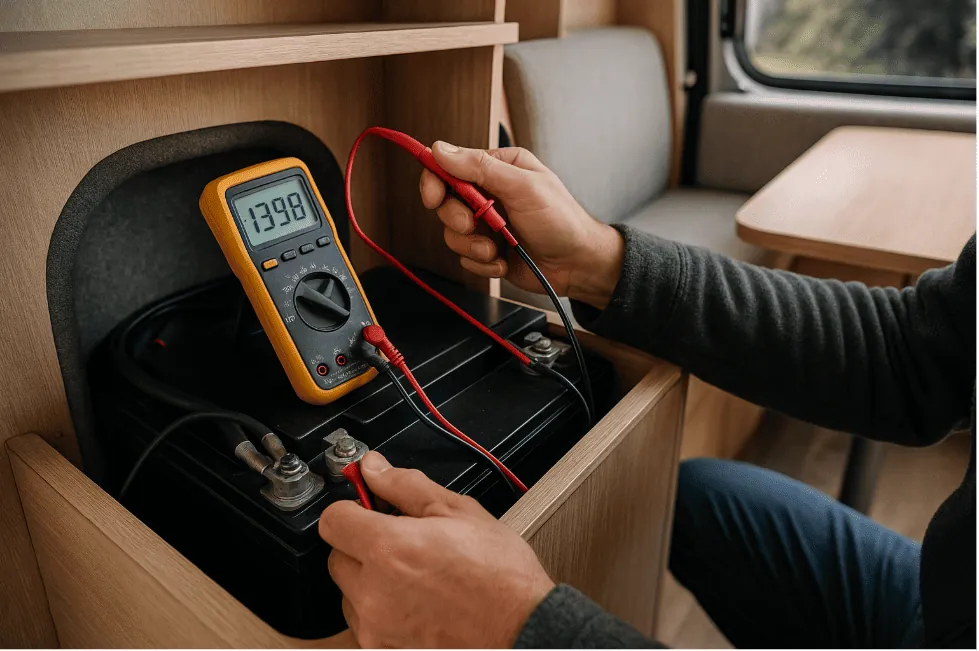
If you're charging from the mains, the charger (or converter) needs to deliver the correct voltage. One way to check: with the battery connected to the mains, measure the voltage; it should be around 13.5V or a little higher while charging. If it doesn't go above that, the charger could be at fault. And watch out: an old charger set up for lead-acid charges lithium poorly.
4. The alternator isn't charging the leisure battery
If the problem shows up while driving, it could be the charging system from the alternator: a split-charge relay not engaging, or a DC-DC charger that's misconfigured or unpowered. With lithium, remember that charging from the alternator must go through a DC-DC charger. We cover this in the DC-DC charger.
5. The BMS has cut off charging (and rightly so!)
In a lithium battery, sometimes it "isn't charging" because the BMS has deliberately cut off charging to protect it: the most typical reason is cold (charging lithium below freezing would damage it) or high temperature. It isn't a fault, it's the protection doing its job. If it's cold, wait for the battery to warm up. We explain this in what a BMS is and in temperature and lithium batteries.
6. The battery has genuinely reached the end of its life
If you've ruled out everything above, the battery might really be worn out, especially if it's a lead-acid one that's a few years old. A battery that no longer holds its charge, swells up, or drops quickly needs replacing.
Diagnose with data
This is where the app becomes your ally again: seeing voltage, incoming charge current and alarms in real time tells you at a glance whether the battery is receiving charge or not, and whether the BMS has stepped in. That points you to the diagnosis without taking anything apart. We cover this in the battery control app.
In summary
If the battery isn't charging, work through in order: terminals, fuses, the charger, the alternator system, and whether the BMS has cut out due to temperature, before writing the battery off. The step you can take today: start with the cheapest and most frequent causes, the terminals and the fuses; they solve a huge number of cases and can save you from buying a battery that may have been fine all along.