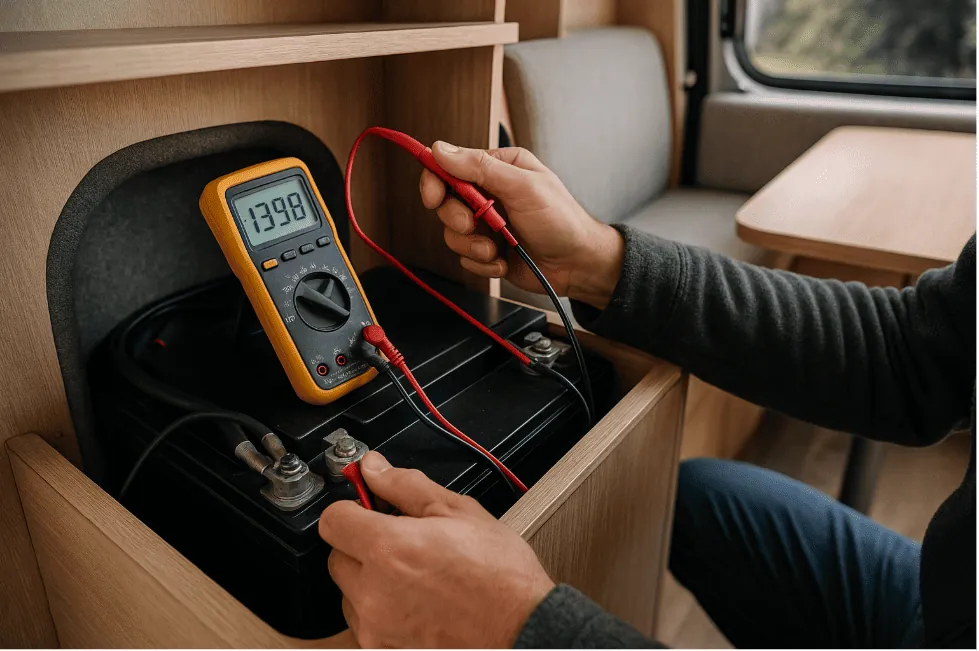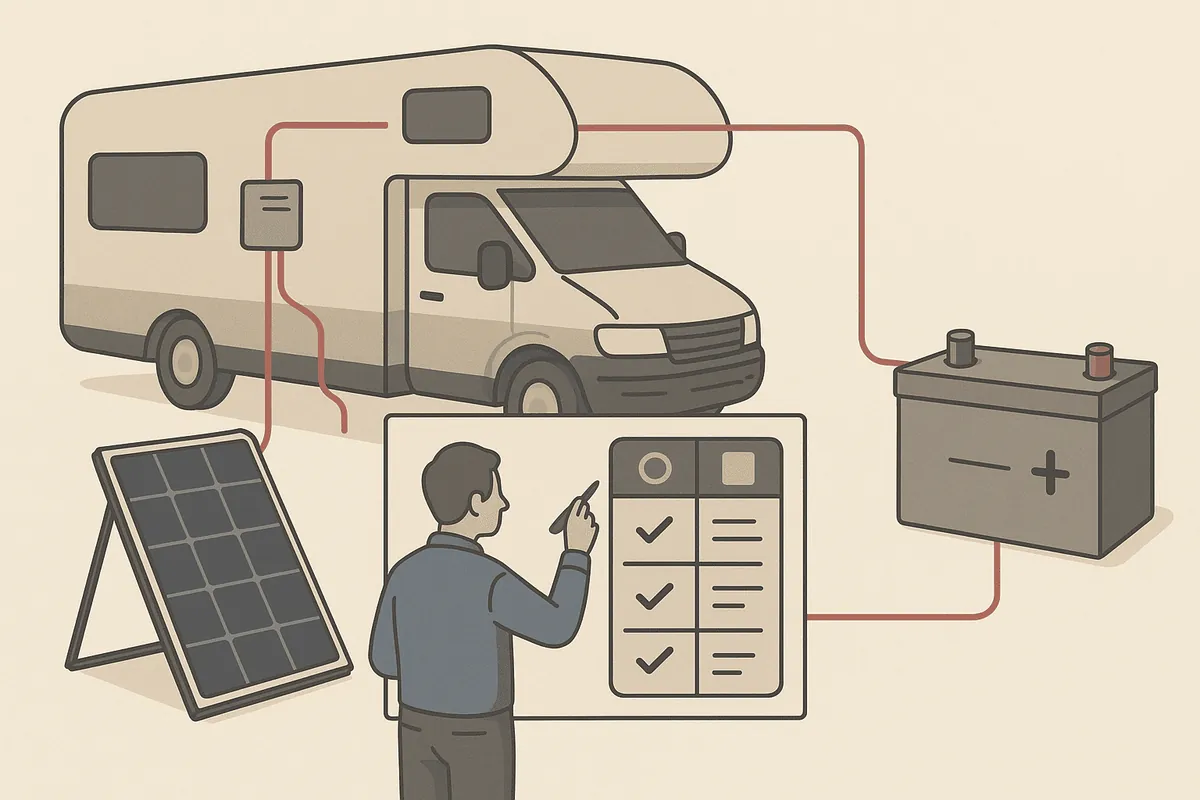

It's mid-afternoon, the fridge is running, and you've got the usual question: will it last until tomorrow, or should you start the engine to charge? With a "silent" battery, all you can do is guess. With a battery connected to an app, you know with a number in your hand. That's what this article is about: what a battery app really shows you, and where its limits are.
Most modern lithium batteries, including Upcyon's, have Bluetooth and connect to a phone app. It's not a tech gimmick: it changes how you manage your power and, for an installer, how you diagnose problems.
What you can see from your phone
A good app doesn't just give you "a battery bar". It shows you real figures:
- State of charge (SoC): the real percentage you have left, calculated from the current going in and out, not estimated from voltage (which is flat and misleading with lithium).
- Voltage and current: how much is coming in (solar or alternator charging) and how much is going out (consumption) at any moment.
- Cell temperature: useful especially in winter and summer, to understand why the BMS is behaving a certain way.
- Cycles and state of health: how many charges the battery has been through over its life.
- Alerts: a warning if something's out of the ordinary.
With this, you stop guessing. You can see, for instance, that your fridge draws X amps and that a sunny morning gets you Y back: now you can plan your day without surprises.
The shunt: why the percentage is reliable
For the battery percentage to be trustworthy, something needs to precisely measure how much energy goes in and out. That's a component called a shunt, a current sensor. In many installations it's a separate device that has to be fitted and wired in. Upcyon batteries have it built in, so the charge figure you see in the app is accurate without installing anything extra. We explain this on the technology page.
The honest limit: Bluetooth isn't "from anywhere"
Let's be clear here, because "remote control" gets misread. Bluetooth has short range: it works when you're near the battery (in or right next to the vehicle), not from your house 200 miles away. Checking the battery while you're far from the vehicle would need a gateway with an internet connection, which is a different thing.
What Bluetooth does solve, and it's a lot, is not having to open the locker or check a panel: from the sofa in the van, or standing outside next to it, you get the full status on your phone. And for professionals, Upcyon also offers remote diagnostic connectivity, built so an installer can check a battery without travelling out to it.
The remote disconnect switch: turning the battery off from the app
One feature that makes a real difference: being able to disconnect the battery right from the app. It's handy for leaving the vehicle stored for a while with no phantom drain, or for cutting power quickly and safely. Instead of hunting for the physical isolator switch, you do it from your phone. It's one of those details that seems small until you leave the van parked for a month and the battery is still fine when you get back.
For the installer: fewer call-outs
If you fit batteries for customers, the app changes the support side of things. When a customer calls saying "it's not charging properly", instead of booking them in you can ask for a screenshot from the app or, with remote diagnostics, check the voltage, temperature and alarm history yourself. Many issues get resolved without a visit. Workshop mode keeps this professional-level management separate from the simpler user mode meant for the vehicle owner.
In short
A battery app turns guesswork into real figures: actual state of charge, live consumption, temperature, cycles and alerts, plus features like remote disconnect. The honest limit is Bluetooth's range, which is local, not global. The one thing to do today: if you already have a battery with an app, spend five minutes checking how many amps your biggest draw uses (almost always the fridge); that figure is the starting point for working out your autonomy, as covered in how much battery your motorhome needs.