"How many amps do I need?" is probably the most common question before fitting an installation. And the answer "just get 200 and you'll be fine" doesn't cut it: either you overspend, or you're out of fridge power by day two. Let's work it out properly, step by step, with no need to be an electrician.
The idea is simple: first add up everything you use in a day, then add a safety margin, and finally convert that into the battery capacity you need. All you need is a list of your appliances and a couple of minutes.
Step 1: list your consumption in watt-hours (Wh)
A watt-hour is simply the watts an appliance draws multiplied by the hours you use it. A 5 W LED bulb on for 4 hours is 20 Wh. Do this for everything you plug in on a normal day:
- Compressor fridge: almost always your biggest draw. It doesn't run all day, just in bursts, so it's estimated by daily consumption. An average camper fridge can be around 300-600 Wh a day depending on size, outside temperature and model (check your own spec sheet).
- LED lighting: small, but it adds up. Several lights for a few hours: 30-80 Wh.
- Water pump: runs in short bursts, very little per day: 10-30 Wh.
- Charging phones, tablet, laptop: 50-150 Wh depending on devices.
- Parking heater (the fan, not the diesel): variable; check your model.
Add it all up. Say you land on, for example, 800 Wh a day. That's your baseline.
Step 2: add a realistic margin
Never size right to the limit. There are days with heavier use, days with no sun to recharge, and losses in the system (the inverter and wiring eat up a share). A 20-30% margin is reasonable. On top of that 800 Wh, budgeting for around 1,000 Wh a day keeps you comfortable.
Also decide how many days you want to last without recharging (your autonomy). If you want two days' buffer with no sun or alternator, multiply: 1,000 Wh x 2 = 2,000 Wh of energy to store.
Step 3: convert Wh to amp-hours (Ah) of lithium
Batteries are sold in amp-hours at a given voltage. To go from Wh to Ah, divide by the system voltage. In a 12 V installation (standard in motorhomes) with 12.8 V batteries like Upcyon's LiFePO4:
Ah = Wh ÷ voltage. Following our example: 2,000 Wh ÷ 12.8 V ≈ 156 Ah.
This is where lithium's big advantage kicks in, as we saw in the comparison with AGM: since you can use 80-100% of its capacity, almost all of those 156 Ah of lithium are usable. With AGM you'd need roughly double the nominal capacity for the same result. In this case, a 150 Ah or 200 Ah lithium model fits, depending on how much margin you want.
An honest shortcut
If all of this feels like too much, here's a rough rule to start with: most regularly-used camper installations land between 150 and 300 Ah of lithium. Under 100 Ah, you'll fall short as soon as you add a fridge; above 300 Ah is usually for bigger motorhomes, heavy remote-work use, or air conditioning. But treat this as a starting point, not a substitute for the calculation: your real consumption is what decides it.
Don't forget the recharging
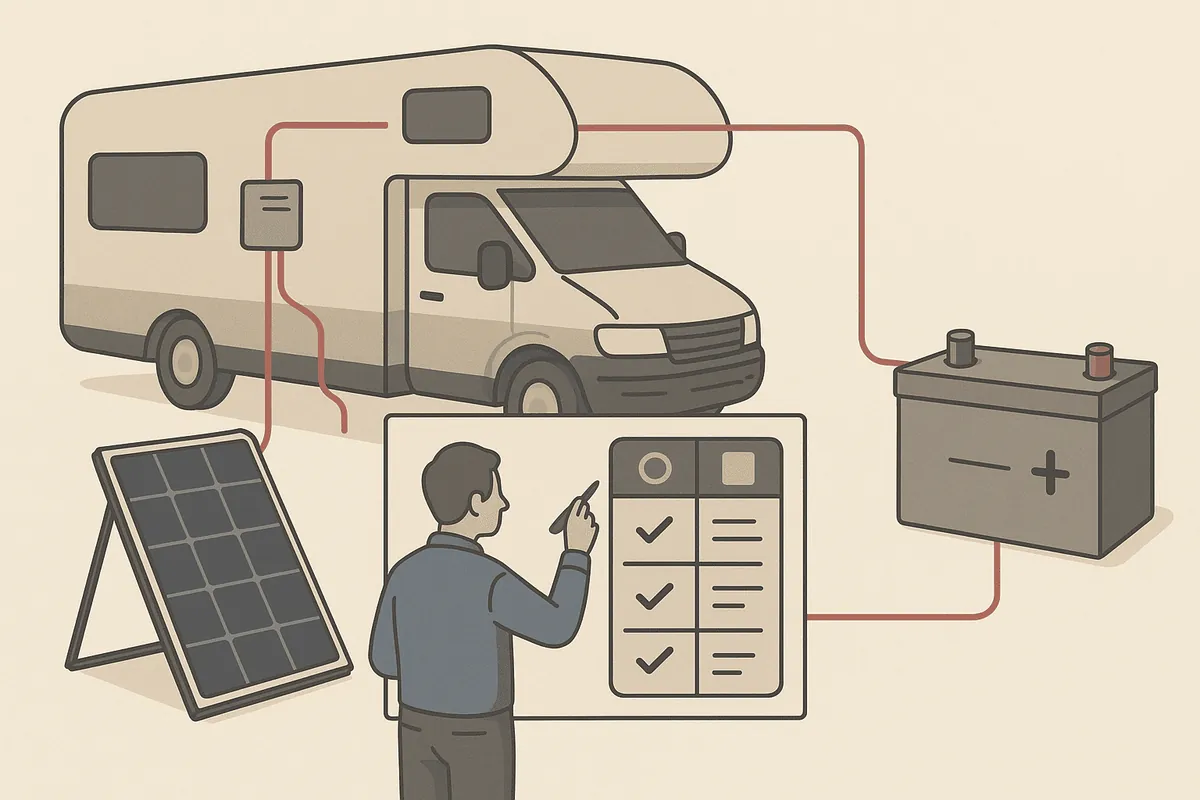
The battery stores energy, but it needs refilling. 300 Ah is no good if all you have is a small solar panel that never quite charges it. Sizing your battery goes hand in hand with sizing your solar panel and alternator charger. For more on this, see how to organise your motorhome's electrical installation.
In short
Sizing your battery means adding up your daily consumption in Wh, adding a 20-30% margin, multiplying by the days of autonomy you want, and dividing by the voltage to get the Ah. With lithium, almost all of those Ah are usable. The one thing to do today: grab paper and note the watts of your three biggest draws (almost always fridge, inverter and device charging); with that, you've already done 80% of the calculation.