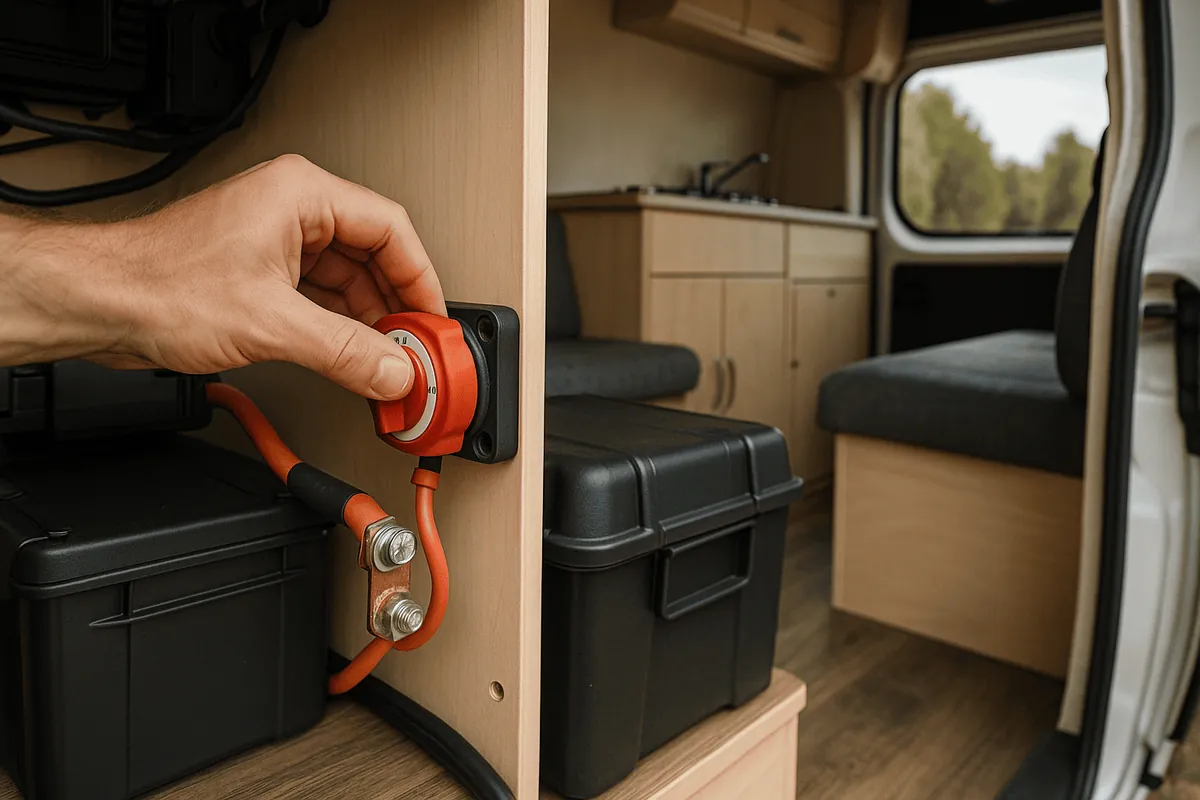

If you open the locker where your motorhome's "control centre" lives, you're met with a jumble of cables, fuses and devices that can look like chaos. But that electrical panel follows a simple logic: it's the command centre that distributes power and protects the installation. Understanding it, even just broadly, gives you a lot of peace of mind and helps you fix small problems without relying on anyone else.
What the electrical panel does
The panel is the point where all the power sources come together (battery, mains, alternator, solar) and from where current flows out to every load (lights, fridge, pump, sockets). Its job is to distribute, control and protect. Think of it like the fuse box in a house, but adapted for a vehicle that combines 12 V and 230 V.
What's inside (the key parts)
- The fuses and protection devices for each line (see fuses).
- The mains charger/converter: which charges the battery when you're plugged into mains power (see the mains charger).
- The solar regulator, if you have panels.
- The DC-DC charger, if you charge from the alternator.
- The control panel: the display that shows battery level, water level, etc.
- The battery connections and isolator switches.
The two worlds: 12 V and 230 V
This is the key to understanding it: your motorhome has two systems. The 12 V one (direct current), which comes from the battery and powers almost everything (lights, fridge, pump). And the 230 V one (alternating current, like at home), which is only available when you plug into mains power or use an inverter. The panel manages both and keeps them separated with their respective protection.
How to make sense of it at a glance
You don't need to be an electrician. Identify where each source comes in (battery, mains hook-up post, panels) and where each line goes. Having a small diagram of your installation stuck inside the locker helps enormously the day something fails. And these days, a battery with an app lets you see the electrical status from your phone without opening anything; see the battery control app.
In short
The electrical panel is the centre that distributes and protects your power, combining the 12 V system (battery) and the 230 V system (mains), each with its own protection. The one thing to do today: draw a simple diagram of your installation (which sources come in, which lines go out) and keep it inside the panel locker; that piece of paper is worth its weight in gold the day something stops working.