Before your first long camper trip the same thing always happens: either you take half the house "just in case" and end up tripping over boxes, or halfway through the trip you realise something basic is missing. Finding the balance is a matter of experience, so here's a realistic list, ordered by priority, of what genuinely gets used. The golden rule: in a motorhome, space and weight are gold, so if you're wondering whether something fits, it's probably surplus.
Safety: what can't be missing
Let's start with what really matters. This isn't optional:
- A carbon monoxide (CO) and gas detector. If you have gas heating or a gas hob, it's essential. CO has no smell and is dangerous; a detector costs little and can save your life.
- A fire extinguisher and fire blanket within reach, not at the bottom of a cupboard.
- A basic first-aid kit and your regular medication.
- Warning triangles or an emergency beacon and hi-vis vests, required as in any vehicle.
- Levelling ramps or chocks: for parking level (sleeping on a slope is horrible).
Water and cooking
- A drinking-water hose (food-grade ideally) and a universal tap adaptor: every water point has a different thread.
- Treatment for the grey/black water tank and gloves for emptying it.
- Just enough kitchenware: unbreakable plates and glasses, a good frying pan, a saucepan, a decent knife and little else. A camper galley rewards multi-purpose items.
- A reserve water container: there isn't always a filling point nearby.
If the water from your tank tastes or smells odd, it's usually down to a lack of maintenance of the system; it's worth disinfecting it from time to time.
Sleep and comfort
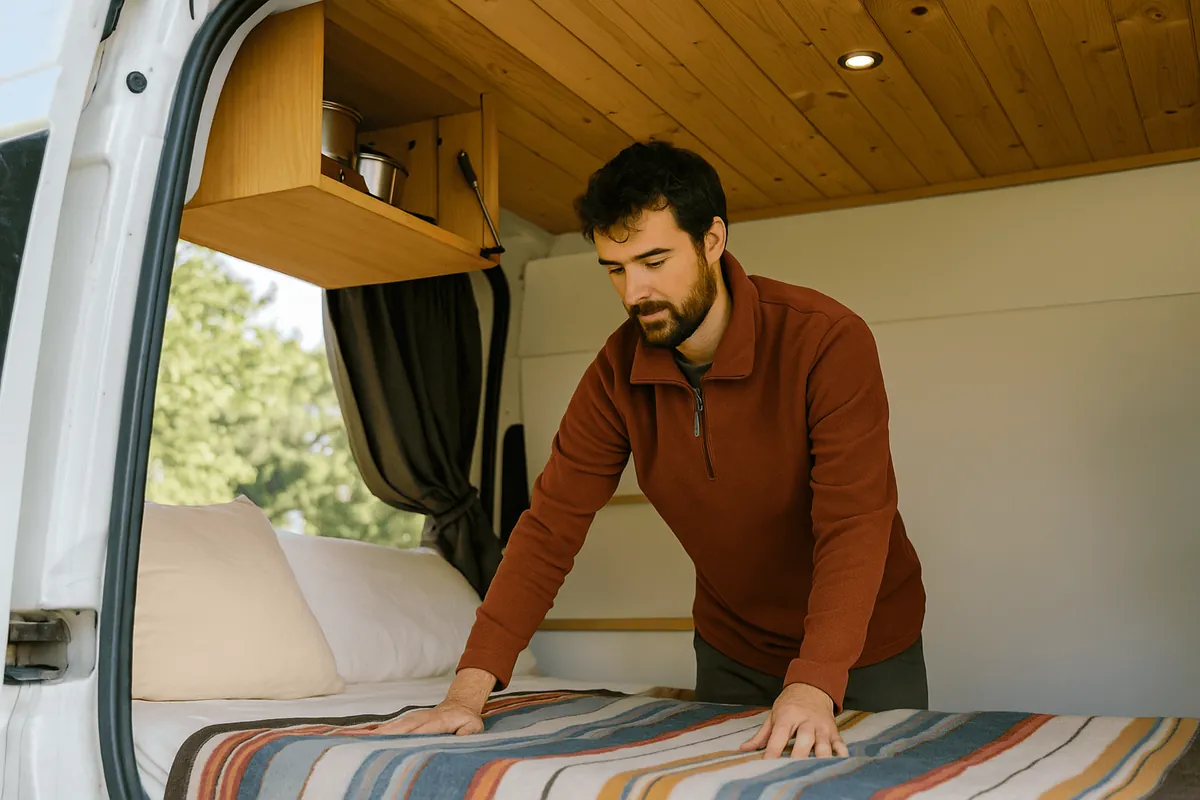
- Blackout blinds or curtains: for privacy and so the sun doesn't wake you at six.
- Sleeping bags or a duvet to suit the season, and a spare blanket: nights get cooler than you'd think, even in summer.
- Fly screens for the windows if you travel in humid areas or near water.
- A fan or, failing that, a good cross-ventilation setup.
Electricity and connectivity
- An extension lead for aire/campsite bollards and the matching adaptors.
- Chargers and a couple of power banks for the days without a hook-up.
- Torches or head torches.
Here, rather than accumulating gadgets, what makes the difference is having a properly sized installation. If you want to know how much battery you need for what you plug in, we explain it step by step in how to calculate your motorhome's battery.
Outside and "camper life"
- A folding table and chairs (remember: only where camping is permitted).
- An awning or drive-away awning depending on your vehicle.
- Rope, pegs and a folding airer.
- An outdoor mat: it stops all the sand and mud coming inside.
The minimum tool kit
You don't need a workshop, but you do need the basics for a silly breakdown: a set of spanners and screwdrivers, duct tape, cable ties, spare fuses, a torch and the vehicle's fluids. That covers 90% of small mishaps.
In short
Good camper equipment isn't the most complete, it's the most thought-through: prioritise safety, take what you genuinely use and be suspicious of "just in case". The step you can take today: before your next trip, make two lists, one of "essentials" and one of "just in case", and leave the second at home; you'll mentally reach for it very few times. And if you want to keep refining, take a look at the tips for your first trip.