
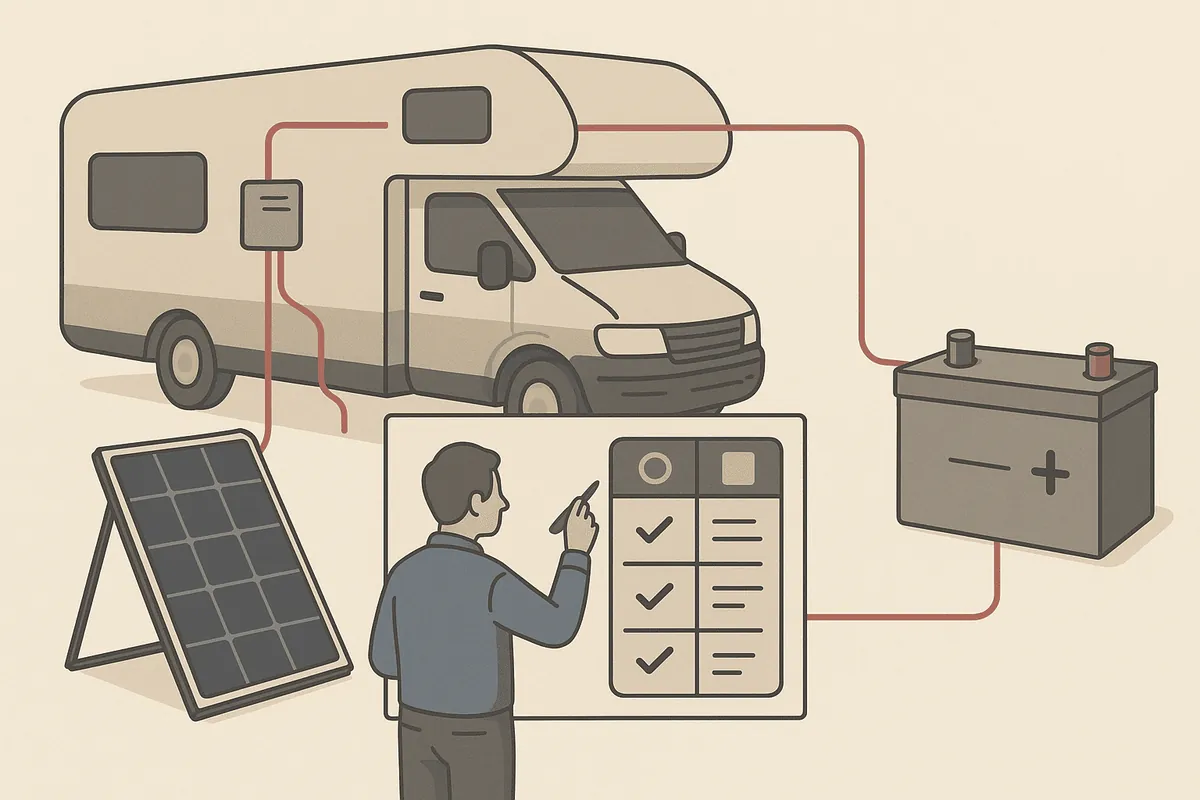
If the battery is your camper's energy tank, the solar panel is the tap that fills it for free on every sunny day. A good solar setup is what lets you spend days away from a plug without losing your fridge or your lights. But you don't need to cover the roof in panels, and a token one won't cut it either: the key is sizing it to what you actually use. Let's get it clear.
What a solar panel does (and doesn't do)
A solar panel doesn't store energy: it generates it and feeds it into the battery, which is what stores it. That's why panel and battery always go together: a big panel with a small battery is wasted (it fills up fast and you lose sunlight), and a huge battery with a small panel never gets filled. The goal is for the panel to replace, on a normal day, what you used the night before.
How much panel you need
As a practical reference, a panel of 100 to 200 W can provide, depending on sunlight and season, roughly 30 to 80 Ah a day. For a camper in regular use (fridge, lights, charging devices), 150-200 W is usually a good starting point; if you work remotely or have heavy consumption, go higher. The proper way to find out is to work out your daily consumption first and then size the panel to replace it; you'll find the guide in how much battery you need.
The regulator: the essential piece
Between panel and battery sits a charge regulator, which adapts the panel's energy to what the battery can safely receive. There are two types: PWM (simpler and cheaper) and MPPT (more efficient, getting more out of the panel, especially in low light). For an installation you want to perform, MPPT pays for itself.
What a panel can't do
Let's be honest about the limits: in winter, with short days and low sun, a panel contributes a lot less; and on a cloudy day, very little. That's why the panel is your main source in summer, but in winter you'll also need to rely on alternator charging (while driving) or the mains. And remember: cold also affects the battery itself, as covered in temperature and lithium batteries.
Solar and a lithium battery: a good match
Lithium (LiFePO4) batteries make especially good use of solar charging, because they accept more current and hold a stable voltage almost to the end, squeezing more out of every hour of sun than a lead battery does. If you're still deciding, lithium or AGM battery can help.
In short
Sizing your solar panel properly means matching it to your consumption, pairing it with a battery to match, using a good regulator (MPPT if you can), and accepting that in winter you'll need help from the alternator or the mains. The one thing to do today: work out how many Ah you use per day first; without that number, buying panels is buying blind. 150-200 W will cover average in-season use with reasonable sun.