You arrive at a campsite or a site with mains hook-up and plug in the motorhome, and a device kicks into action to fill your auxiliary battery: the mains charger (also called a converter or 230V battery charger). Choosing it correctly, or knowing whether the one you have is right, is the difference between a fast, full charge and always being left half-charged. Let's look at it.
What the mains charger does
The charger takes the 230V from the socket and converts it into the direct current your battery needs to charge, at the correct voltage. It's the fastest, most predictable way to fill the battery to 100%, ideal before setting off on a trip or during a stay at a campsite.
The key detail: the charging profile
Here's the most important part, and where most people go wrong: each battery type charges differently. Lead-acid types (AGM, gel) and lithium (LiFePO4) need different voltages and charge curves. An old charger set up for lead charges lithium poorly: it leaves it half-charged or forces the wrong voltages, and vice versa too. That's why, when switching to lithium, you need a charger with a lithium profile, or a configurable one. It's a cheap change that avoids autonomy problems that later get unfairly blamed on the battery.
What power rating (amps) you need
Chargers are rated in amps: more amps, faster charging. The right rating depends on your battery capacity; too low and it takes forever, too high and it doesn't help if the battery can't take it. A charger matched to your battery bank fills it in a reasonable time without straining it.
Full charge, healthy battery
A correct, full charge doesn't just give you more autonomy: it also extends your battery's life. A battery that rarely gets a full charge, or is charged incorrectly, ages faster. Modern lithium batteries, like Upcyon's, manage their charging via the BMS and show the process in the app, so you can see it's charging properly. If you're still deciding between technologies, lithium or AGM can help.
The charger and your other sources
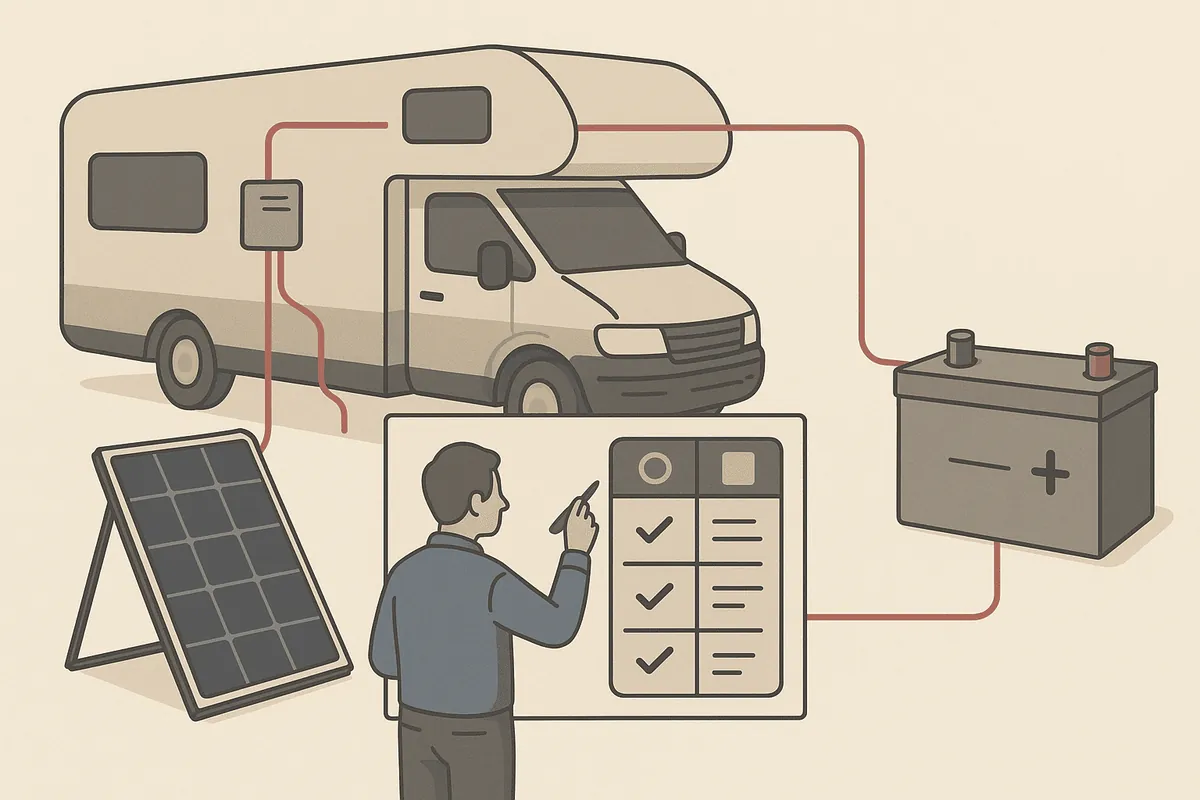
The mains charger is one of your three charging sources, alongside the alternator (via a DC-DC charger) and solar panels. Each covers a different situation; together, they give you autonomy in almost any scenario.
In short
The 230V charger fills your battery whenever you're plugged in, and the crucial thing is that it has the correct charging profile for your battery type (lithium or lead) and a rating that matches. The one thing to do today: if you have a lithium battery, confirm your charger has a lithium profile or is configurable; charging lithium with a lead profile is the hidden cause behind a lot of autonomy problems.