
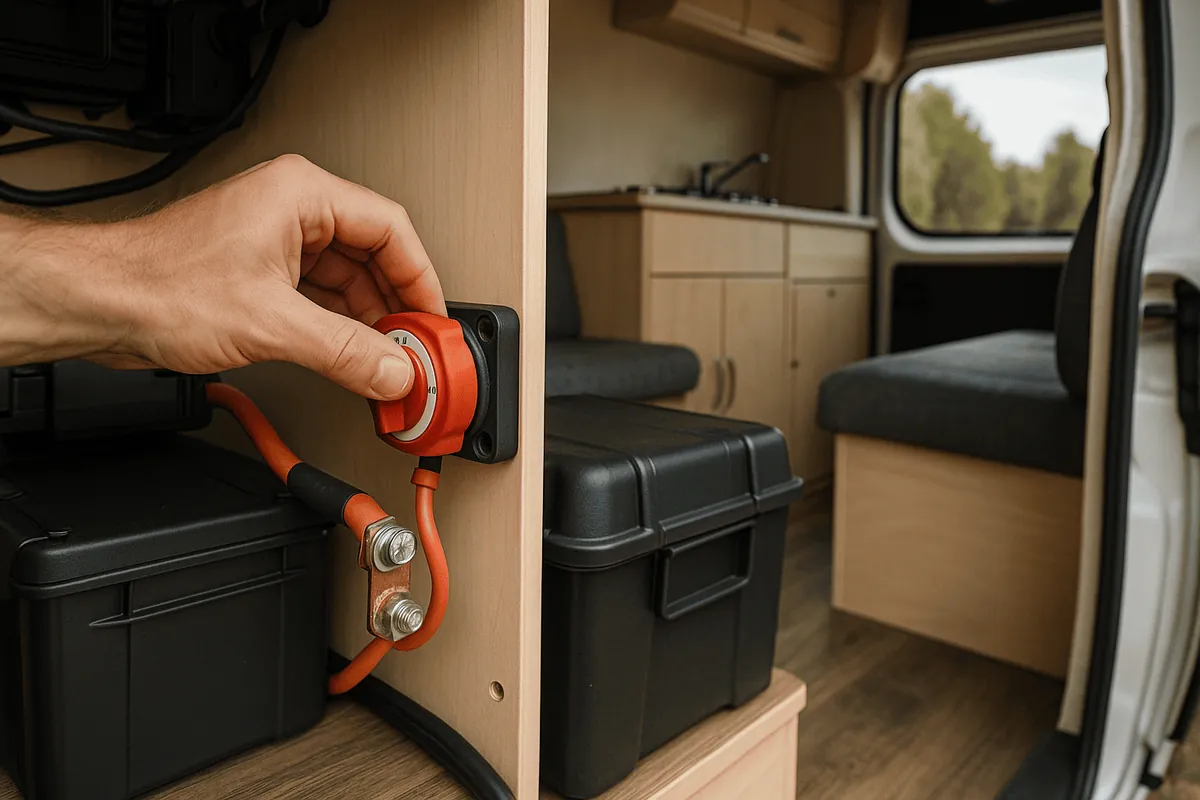
Living aboard a sailboat or a boat, anchored in a cove far from marinas, depends on the same thing as camper life away from campsites: self-sufficient power. The keys to power on board are first cousins of those of a motorhome, and anyone who has mastered one quickly understands the other. Here we explain the pillars of on-board power for living freely at sea.
The parallel with the camper
A boat that wants to live at anchor (without plugging in at the pontoon) needs exactly the same thing as a camper that wants to sleep off-grid: to generate, store and manage its own power. The components and the principles are the same, only the setting changes (see lithium on boats).
The pillars of power on board
- Generation: solar panels (the most used and the quietest), the engine's alternator, and sometimes wind or hydro generators (at sea, the wind is more constant than on land).
- Storage: the batteries. Here LiFePO4 lithium makes the difference: more usable power, longer life and lighter weight than lead-acid, just as in a camper (see lithium vs. lead-acid).
- Management and monitoring: knowing how much power you have and how much you're using (a good monitor/shunt) is key so you don't run out of battery far from port.
What draws power on board
On a boat, some loads are vital: navigation lights, instruments, VHF, bilge pumps, autopilot, fridge. Others are for comfort (charging devices, pressurised water). Knowing them and sizing the battery with a margin is essential, because at sea there's nowhere to easily top up power (the sizing principles are the same as in a camper; use the calculator as a guide).
Why solar rules
As with a camper, solar is the ideal foundation of power on board: silent (key to the calm of an anchorage), no moving parts, reliable and free. Combined with a good lithium battery that makes the most of every watt, it lets you live at anchor for days without depending on the engine or the marina. It's the same formula that has set campers free, applied to the sea.
In summary
Power on board for living at anchor rests on the same pillars as camper autonomy: generate (mainly solar), store (LiFePO4 lithium) and manage (monitoring), sized to your loads. The step you can take today: if you want to live aboard with autonomy, invest in solar plus a good lithium battery and a good consumption monitor, sizing your vital loads with a margin; it's the same philosophy that sets a camper free. Combine it with lithium batteries for boats.